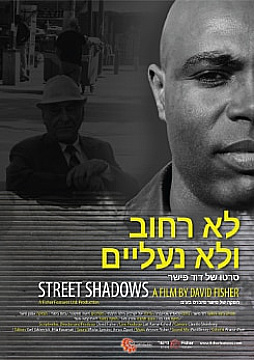
"Street Shadows" (Hebrew title: Lo Rechov Ve'lo Na'alayim, literally "Neither Street Nor Shoes") is an urban parable, ironic and universal, touching in its essence — where humor cannot mask the deep pain shared by both the old-timers of Tel Aviv's Neve Sha'anan Street and the asylum seekers who arrived there. The film makes no pretense of offering solutions to the tensions running through this crowded, complicated street, but it offers an understanding: that the street, with its shifting cast of residents, is simply part of the fabric of any major city today.
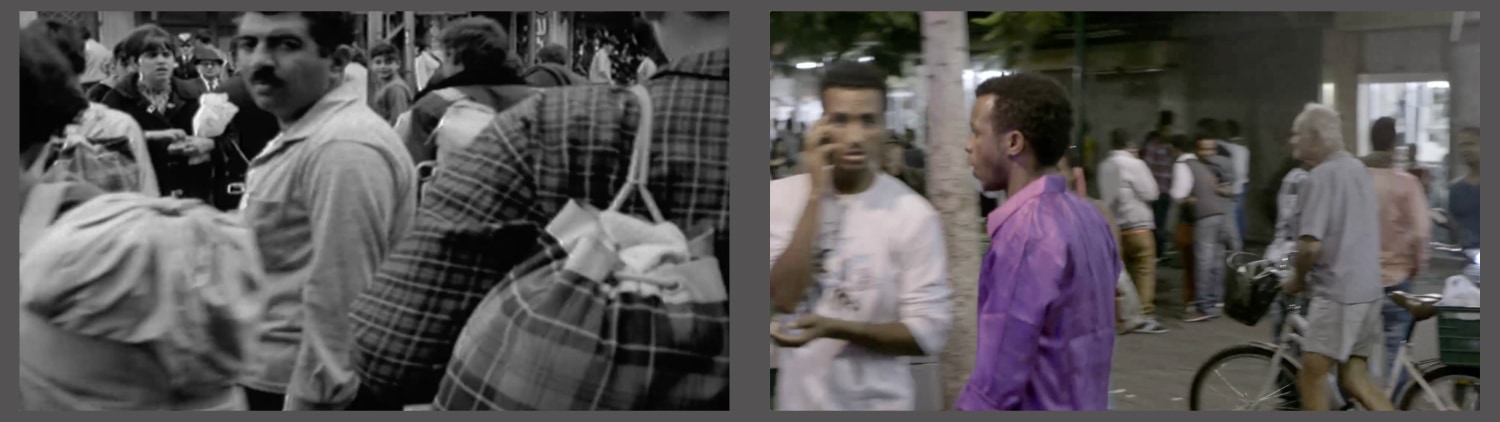
What hasn't this street seen? It feels like a place worn down by history — battered, but never quite broken. The journey down its short length, rich beyond its size in memory and human experience, moves through courtyards and passageways, shopfronts and stairwells, gathering a mosaic of faces that adds up to something new, and at times surreal: a place with real charm, though not always grace or mercy. Once, in the 1960s and '70s, it was a street alive with motion — thousands passing through it daily. David, the director, then a boy growing up in Petah Tikva, would come here with his grandmother to shop and wander, even at the cost of a school day. In those years, the local locksmith hosted the singer Trifonas on Friday afternoons, and the shopkeepers took pride in calling their street the Israeli Champs-Élysées.
Fifty years on, and just as his grandmother once did, the director returns to listen to the street's stories. But most of what he remembers is gone. The old-timers left, save for the few who had nowhere else to go. Today the street belongs to foreign workers and asylum seekers, still searching for a way to hold on. Nostalgia alone means little here — what it opens up instead is a question: has something truly gone wrong since then, or has the street only ever been what it always was — a stronghold of the displaced, of people with no present tense, left to either dream of a future or grieve a vanished past. Even the street's elders, ashamed of what it has become, arrived here once as refugees themselves.
Who designed this street, and why, and who gave it its name? The son of architect Yosef Tischler explains that his father laid out Neve Sha'anan for the Jewish refugees who fled Jaffa after the riots of 1921 — shaping it, deliberately, like a menorah. It was architect Israel Godovich who shattered the fantasy that the street would ever become Tel Aviv's Champs-Élysées: "Neither Street Nor Shoes," he ruled — and gave the film its name. Since its founding, the street has taken in wave after wave: Jewish refugees from Jaffa, Holocaust survivors, Jews fleeing Iran, laborers from Romania and Moldova, workers from China and the Philippines, and in recent years, refugees from Sudan and Eritrea.
The journey through Neve Sha'anan digs into the universal idea of displacement, and the collective ache for something called home. This is a film without heroes — but not without heroism, and not without the quiet, ongoing struggle of people who chose this place, or simply landed in it.
In the Words of Director David Fisher:
Why is the south always the one left behind? Why here, of all places, that tens of thousands of African refugees were brought? How was anyone meant to work out a relationship with the people who already lived here? In my films I usually try to escape "issues" in favor of people — but here, in Street Shadows, it was clear from the start that there were no heroes, no villains. That made it hard, because there was no ready-made story, and to this day I'm not certain I've found one. It was only when I understood the film I was making wasn't about arriving anywhere, only about the journey there — that I wasn't on some crusade to find who started it, who's to blame, who's right — that I could finally breathe. I found myself asking, not for the first time, what I actually am: an artist, or a messenger? Do I have something to deliver? Can a film like this change anything at all?
I walked the length of Neve Sha'anan — just 350 meters end to end — again and again. Liat, the producer, cleared the way ahead of me, steadied my nerves, and believed in it before I did. When I finally felt ready, I went out with Claudio, the cinematographer, to talk with people. Not interview them — talk. The difference matters: I came prepared for the encounter, but deliberately unprepared for the conversation itself. That's not a trick of phrasing. It came from wanting to stay open to whoever was in front of me — to what they had to say — rather than fitting them into the shapes I could have predicted from research done in advance.
Armed with a camera held at eye level, I set out to tell this street's story through the eyes of the people who live on it and live off it. I chose to shoot and edit in the style of Israeli novelist Yaakov Shabtai, whose stream-of-consciousness prose in Past Continuous follows one thing leading to the next, one person leading to another. The people in this film are heroes only for a moment; often, we never meet them again. The street's human mosaic — its real condition today — brings together, side by side, refugees from Africa, Jewish shopkeepers, old-timers born and raised here, passersby, and anyone with something to say. Every one of them is a story.
When I came back with dozens of hours of footage, I sat down to find the logic in all that wandering — to weave the faces into a mosaic, the way a mason fits interlocking paving stones. And then I heard my brother Amnon Fisher's song "Osher" ("Happiness"), and something clicked. The film and the song became one.
This was a journey in which I came to know a different Israel — and one I now invite you to join.